
While the old world was crumbling...
...geeks hiding from the ruin invented all modern design.
The destruction of the world and the end of an era is not a figure of speech — in 1974, that is exactly how it felt. The Cold War and the nuclear threat, Watergate, the fading echoes of the sexual revolution, and the conservative backlash. The era of hippies and psychedelics ended as quickly as it began.
Yet at Stanford, there was an AI lab that seemed to refuse to accept this changing reality. Beards, conversations about AI, robotic arms, a sauna in the basement. By all accounts, the atmosphere there was hermetically sealed in 1968. I personally imagine it as a mix of The Big Bang Theory and old Microsoft group photos.
It was there, in 1974, that a young Dan Swinehart presented his doctoral dissertation on a programming assistant called COPILOT. The rhyme with GitHub Copilot is far more interesting than a mere coincidence.
Here is what computers looked like back then. The workflow was: write code on paper, transfer it to a punch card, insert the card, wait a couple of days for calculations, and receive an error report. Computers were blind. Monitors and lights were already being connected, but they were of little use because all calculations ran in a single thread. The computer simply worked, and until it finished, it stood there calculating and nothing else.
The COPILOT idea introduced a layer of abstraction — an additional environment, a “second thread” for the computer, and a partner for its operator. Effectively, Swinehart invented the IDE and the terminal. This second thread had access to the first, could monitor its state, and display it — allowing you to write code right there or control its execution.
For the first time, while the computer was working, you could communicate with it directly through a digital interface. In reality, this was the first digital interface for communicating with a machine. It set the rules by which we continue to create digital design today.
The irony of this historical rhyme — two Copilots released 50 years apart — is that the old one was also invented in an AI laboratory. Which makes the phrase “An AI copilot to help programmers was actually invented in 1974” technically true.
But I like the second layer even more. “Copilot” is a clear and logical word. A helper. Effectively a synonym for “interface.” Swinehart’s Copilot was an additional layer of abstraction over computing power. Since then, many new layers have formed over that one. And every time, a new layer of abstraction means a new layer of simplified interaction.
I have a suspicion that AI is something like the “Final Boss” of interfaces. It signals the completion of graphical interfaces. Not that they will disappear, but that they are becoming a local story, while the main interaction moves to another plane.
In short: COPILOT was the first interface, and COPILOT 50 years later is closing the era of interfaces.
All this revolves around one document: a PDF scan of this dissertation, which impressed me greatly. I highly recommend you look at it, even if just from a purely aesthetic point of view. If you have 15 minutes, read the table of contents, abstract, and intro.
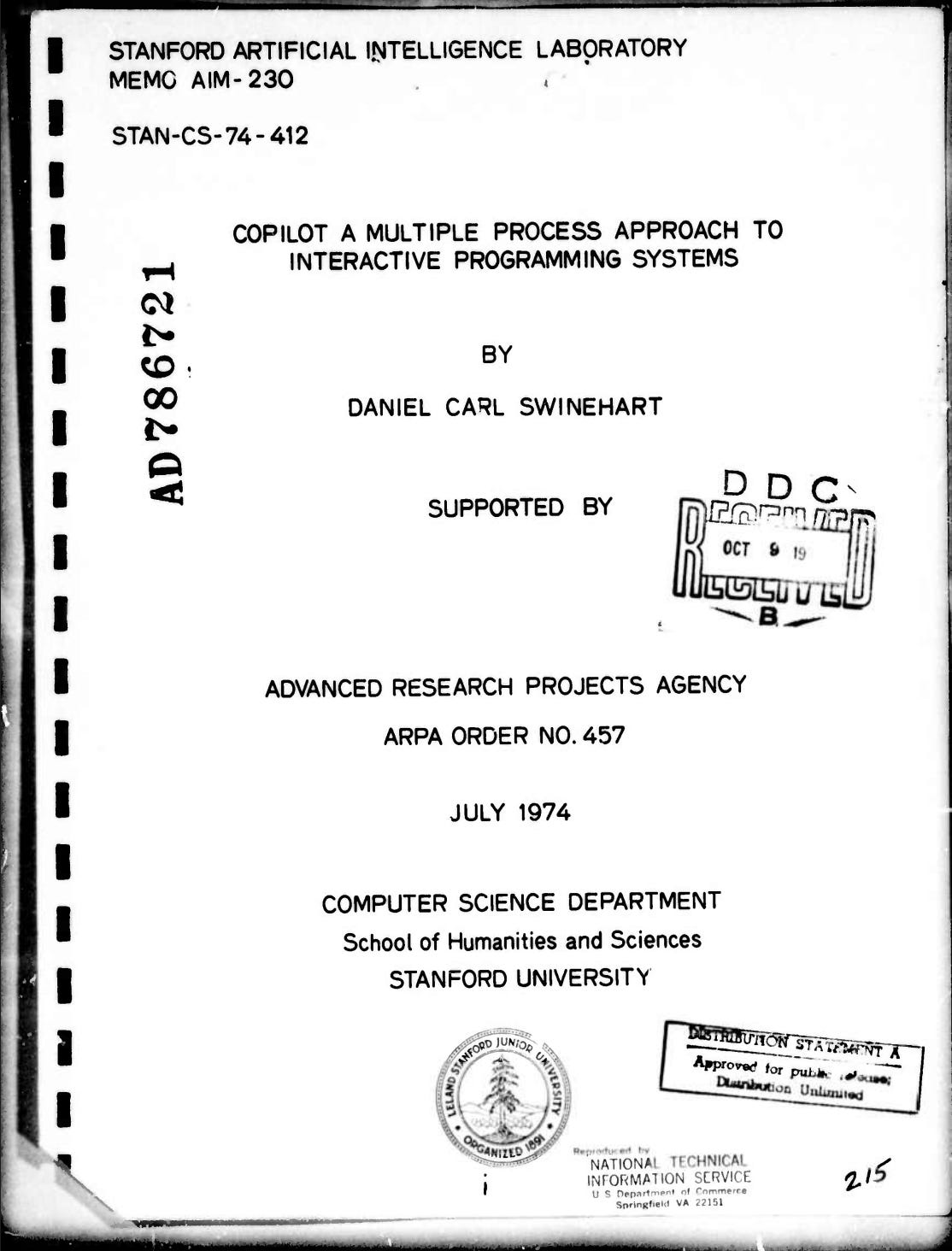
https://apps.dtic.mil/sti/tr/pdf/AD0786721.pdf
Love,
Ilya